
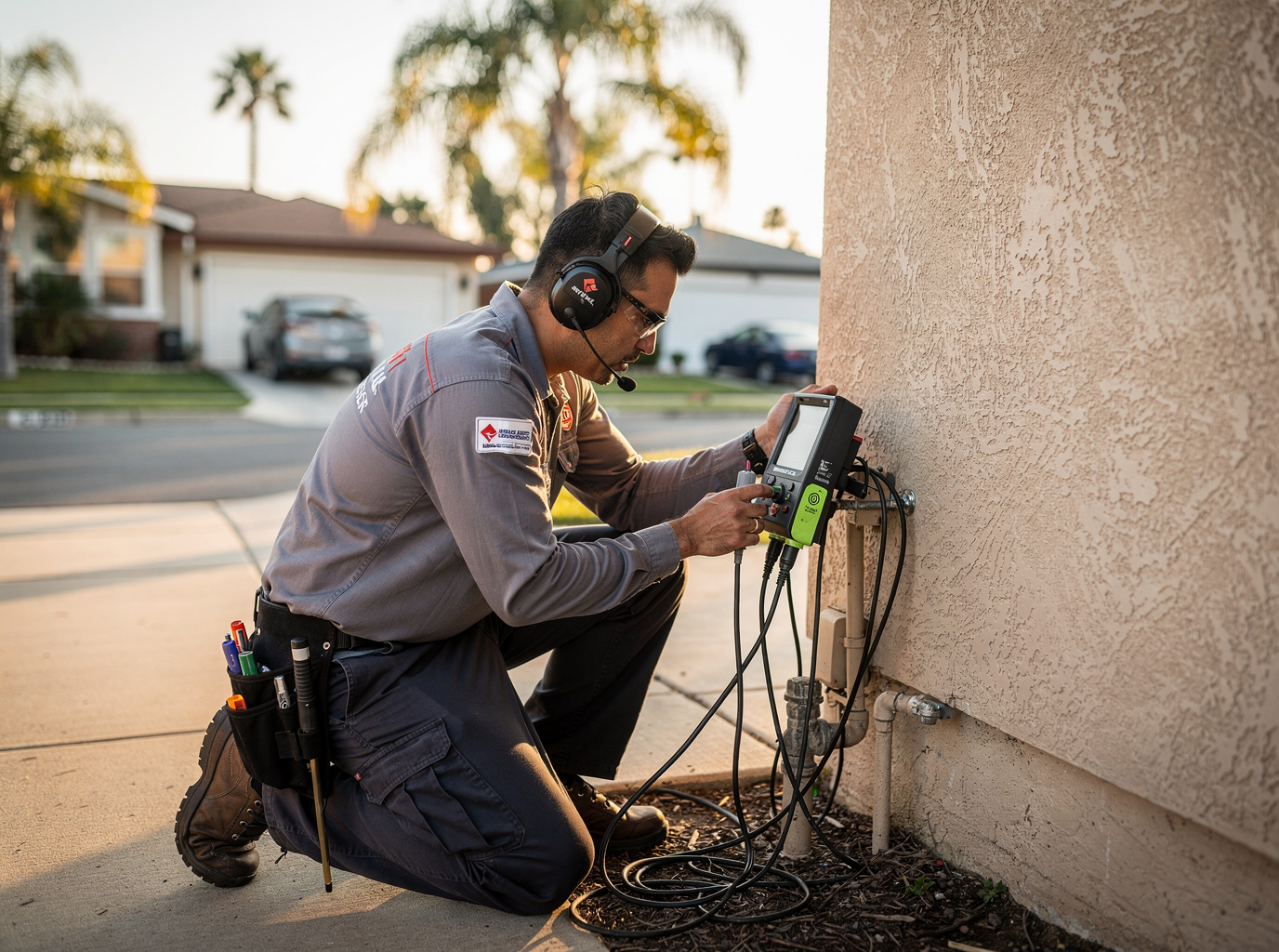
Long Beach's diverse neighborhoods near the Port of Long Beach feature older housing stock where ocean-moderated salt air drives pinhole leaks and joint failures in copper lines. The mild Mediterranean climate cuts freeze damage yet promotes condensation leaks inside crawl spaces of mid-century homes along CA-1 and I-405. Detection crews here routinely trace slab leaks caused by shifting soils around the waterfront and Queen Mary area while navigating dense urban layouts and Aquarium of the Pacific traffic patterns.
Leak Detection in Long Beach — What We Handle
- ✓Salt-air corrosion accelerates pipe failures in port and waterfront properties unlike inland cities.
- ✓Non-invasive acoustic and camera work is required around historic Queen Mary and City Hall structures.
- ✓High water-table conditions near the Port of Long Beach demand specialized slab-leak equipment.
Leak Detection Services We Offer in Long Beach
✓Slab Leak Detection
We use acoustic sensors and thermal cameras to locate leaks under concrete slabs common in Delhi and Logan homes without breaking floors until the precise spot is marked.
✓Water Line Leak Detection
Pressurized testing and inline camera work pinpoint leaks on the service line from the meter to the house, especially useful for older galvanized lines in Downtown Santa Ana.
✓Camera Pipe Inspection
A waterproof camera travels through accessible lines to record cracks, root intrusion and joint separation that cause hidden leaks near the Santa Ana River corridor.
✓Non-Invasive Moisture Mapping
Infrared and moisture meters trace water migration behind walls and under tile in French Park and Park Santiago homes so repairs stay limited to the affected area.
✓Underground Leak Location
Sonde transmitters and ground microphones locate leaks on irrigation and main lines buried in the clay-heavy soil found throughout Heninger Park and Lacy.
Santa Ana’s older housing stock in neighborhoods such as French Park, Lacy and Heninger Park often contains galvanized or early copper lines installed before the 1970s. These pipes corrode from the inside and leak at joints where soil movement along the Santa Ana River floodplain shifts the ground. Electronic listening devices and thermal imaging let us trace the sound or temperature change through concrete slabs and stucco walls without random demolition that later requires patching permits from the city.
Mediterranean summers push water temperatures higher, expanding older fittings and accelerating pinhole leaks that surface only after water migrates under tile in Park Santiago or Artesia Pilar homes. We isolate the line, introduce pressurized air or nitrogen, then confirm the exact breach with an inline camera before any excavation. This approach satisfies Orange County health-department backflow rules that require documentation whenever a leak repair crosses a meter.
How It Works in Long Beach
- 1
Initial Assessment
We review the water bill, meter flow and visible signs at the Santa Ana property to narrow the likely leak zone before any equipment is brought inside.
- 2
Electronic Listening
Acoustic sensors are placed along walls and slabs to detect the high-frequency sound of escaping water in older copper or galvanized systems.
- 3
Camera Confirmation
Where access allows, we run a camera to visually confirm the breach and measure distance from a cleanout or fixture.
- 4
Mark and Report
Exact location is marked on the surface and a written report with photos is provided for insurance or city permit needs.
Serving All of Long Beach
We regularly handle leak detection jobs near:
- 📍Queen Mary
- 📍Aquarium of the Pacific
- 📍Long Beach City Hall
- 📍Port of Long Beach
Leak Detection Pricing in Long Beach
Upfront quote after we confirm access and pipe material; most leak detection jobs fall into the ranges below.
Want the full picture of this service? See our Leak Detection page, or everything we do in Long Beach, CA.